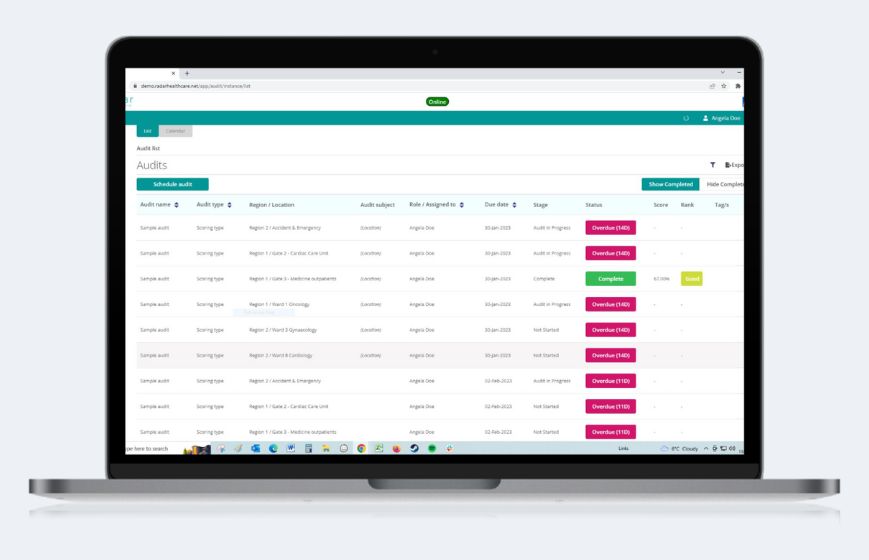



Empowering Patient Safety: Innovations in Learning from Patient Safety Events (LFPSE)
In our latest webinar with Digital Health and Guy’s and St Thomas’ Foundation NHS Trust (GSTT), we explored the topic of Learning from Patient Safety Events (LFPSE) and how innovative approaches can improve patient safety outcomes on a broader scale.
Charles Martin, Head of Risk and Quality Assurance at Guy’s and St Thomas’ NHS Trust, joined Paul Johnson, CEO of Radar Healthcare, and Jack Forshaw, Project Manager Lead and LFPSE Champion at Radar Healthcare, to discuss the implementation of the new LFPSE service and its real-world impact.
Watch the full webinar recording to learn how technology is helping provider organisations support local safety governance and improve care quality.

Exploring Innovations in LFPSE
During the webinar, our speakers discussed their collaborative partnership and how technology has helped Guy’s & St Thomas’ adapt to new safety events LFPSE service frameworks, contributing to both national and local safety initiatives.
In this blog, we cover the key takeaways from the discussion and share best practices for organisations moving forward with LFPSE and local patient safety response improvements.
Meet our Expert Panel
-
Paul Johnson
Chairman and Non Executive Director at Radar Healthcare
-
Jack Forshaw
Project Manager Lead and LFPSE Champion at Radar Healthcare
-
Charles Martin
Head of Risk and Quality Assurance at Guy’s and St Thomas’ NHS Trust
-
Tammy Lovell
News Editor (Chair) at Digital Health
"When searching for an incident reporting system, our goal was to make reporting easier, which has resulted in an increase in incident reports—a significant positive outcome.”
Introduction to GSTT and Their LFPSE Journey
In our webinar, Charles shared Guy’s & St Thomas’ transformative journey with the new LFPSE service. He detailed how they integrated it into their incident reporting and management processes, using Radar Healthcare to record patient safety events and support local safety improvement work across the Trust.
By focusing on the end-user experience, Guy’s & St Thomas’ ensured that recording patient safety events became a meaningful step toward safer care—not just another compliance task. Their story highlights how clear strategy and the right technology can help provider organisations improve safety outcomes while meeting national standards.
Charles recounts Guy’s & St Thomas’ 2-year LFPSE journey and their approach to finding the right solution to support them:
“We established a two-year transformation programme centered around LFPSE. The primary reason for this initiative was our merger with the Royal Brompton and Harefield Hospitals in 2021, which formally transitioned in 2022. This merger provided an opportunity to evaluate and align our overall processes. However, we encountered significant obstacles, such as operating on completely different networks and using three different types of local risk management software and different electric health records (EHR) systems. Therefore, we embarked on a comprehensive programme to streamline our processes, with LFPSE and PSIRF (Patient Safety Incident Response Framework) as our focal point.
In 2022, we initiated a procurement exercise to find a new risk management software, ultimately selecting Radar Healthcare. This process involved setting up an initial transformation programme team that integrated into our overall merger model for Royal Brompton and Harefield Hospitals. Now that the programme has concluded, we are beginning to see the benefits of implementing the new system, fully rolling out LFPSE and PSIRF, and successfully reporting to NHS England via our new incident management system.
Looking ahead, the true measure of our progress and success with these new processes will be in December 2024, marking one year since implementation. However, we are pleased with our progress and our partnership with Radar Healthcare.”
The Radar Healthcare platform allowed the team to access data across systems and improve patient safety while supporting local governance and compliance goals
"We had a fantastic reporting team that greatly contributed to the successful implementation of Radar Healthcare and LFPSE. Sarah Adams from Radar Healthcare served as our Project Manager and maintained constant communication with us. She fostered a strong relationship with our team, making it easier to progress and align with our internal goals, as well as align with national directives like LFPSE and PSIRF."
Best Practices and Lessons Learnt for Adopting LFPSE
The webinar highlighted that robust communication and genuine collaboration are essential when successfully adopting a single national NHS system like LFPSE. Consistent and clear dialogue between teams and departments is crucial, fostering a culture that prioritises not only patient safety but the frontline staff reporting incidents and following the processes confidently using the online service.
Guy’s & St Thomas’ experience demonstrated the importance of having clear goals and an internal risk strategy before implementing national directives, such as LFPSE. Understanding your organisation’s unique goals and aligning them with broader objectives ensures a tailored approach that resonates with your team and accommodates your local area’s needs. This process, grounded in open conversations and shared visions, makes the shift to LFPSE a shared commitment to improving patient outcomes.
It also supports both strategic executive information system goals and local safety governance priorities.
Charles explains further, “Aligning internal goals with the needs of NHS England can be challenging. While there are prescribed frameworks, it’s essential to develop incident report plans that suit the needs of our local area based on specific risk factors. With LFPSE, there is a need to collect specific types of key incident data, such as those related to medicine, pressure ulcers, and falls. We had to think creatively to ensure we met national reporting requirements while still identifying key risk areas for ourselves.
Functionality-wise, we focused on user feedback to determine if they could obtain necessary data from other sources. For areas like mental health, administrative safety, and pediatric authorisation, much of the needed information was already in our EHR. The key was linking this data between the systems using the patient’s MRN (medical record number) and conducting analysis within Radar Healthcare or offline. Integrating systems and processes to reduce duplication and save time was crucial for us. We wanted to make reporting and analysis as easy as possible for people.”
Charles continues, “When setting up our key initiatives, our primary goal was to establish a user-centric approach and empower access to our data with the new system, starting with a new incident reporting form. As a collective, our programme team, along with all our clinical groups, agreed on a central objective for the overall programme: to make the incident form as short as possible. This was very important to us.
We recognised potential risks from implementing LFPSE, anticipating a significant change with additional questions and areas to address for NHS England. However, our goal was to simplify the process for end users to capture and report incident data while ensuring we had sufficient information to respond to needs identified through our local patient safety incident response plan.
The key enablers for this were, first, integrating our systems to save time for reporters, and second, avoiding over-reliance on pre-existing information from NHS England to ensure we could still address local needs.”
By streamlining systems and assigning relevant individuals access to key data, the organisation reduced duplication and enhanced its local patient safety response.
Their new incident management solution enables provider organisations to record a patient safety event, update event records and submit them to the national NHS system through an intuitive online service.
“I believe the key to success lies in aligning our desired outcomes with initial usability and user-friendliness. This approach is crucial from the outset of any framework or process implementation, including LFPSE. Establishing a predefined taxonomy provides a solid foundation of documentation to build upon and support future processes effectively. Early engagement with users is essential right from the start, guiding and shaping our progress throughout the implementation process. At Radar Healthcare, we believe in maintaining a consultative approach throughout, ensuring continuous refinement leading up to the go-live stage and beyond."

Technology Supporting Organisations Adopt LFPSE
Technology can play a crucial role in the implementation of frameworks like the LFPSE and PSIRF, helping to streamline data collection, analysis, and reporting, allowing healthcare organisations to identify and address safety issues more efficiently.
From automating compliance checks to simplifying how safety events are recorded, a strong digital platform allows teams to act fast and improve outcomes.
Moreover, it fosters a culture of continuous improvement by facilitating better communication and collaboration among healthcare teams.
In 2021, Radar Healthcare became the first supplier to achieve LFPSE compliance, collaborating with NHS Improvement and Milton Keynes University Hospital NHS Foundation Trust, the first NHS Trust in the UK to implement the national LFPSE service.
Radar’s online service offers users the tools they need to request read-only access, assign relevant individuals access, and manage records, helping organisations support both national reporting and local safety improvement work..
Our ongoing commitment is to give healthcare providers – from NHS Trusts to community pharmacies, dental and optometry practices – with the tools they need to manage risk, compliance, and continuing professional development more effectively.
We ensure our software is tailored to their specific needs rather than adopting a ‘one-size-fits-all’ approach.

Empowering NHS Trusts with Flexible, Collaborative Technology Solutions
Paul Johnson, CEO of Radar Healthcare said: “We as technology partners must be flexible, because the industry is so dynamic. One of the biggest challenges from the start was balancing the Trusts’ clearly defined incident risk strategies with national directives. For example, LFPSE uses a fixed taxonomy, so we had to figure out how to align NHS Trusts’ internal strategies with national reporting requirements. As a technology partner to NHS Trusts, this was one of our major challenges.
To address this, we collaborated closely with each organisation, working on how to integrate both internal strategies and national directives into their processes within Radar Healthcare. We are committed to Radar Healthcare functioning as a learning management system, enabling organisations to respond proportionately to incidents while ensuring compliance with both internal and national requirements. And as I said, we do this through collaboration and equal partnership.”
Paul continues to explain: “We take a very personal approach, by working in partnership we can understand that organisations like Guy’s & St Thomas’ have a user-centric focus. As technology partners, we are obligated to ensure that our system can accommodate this approach.
One of our unique selling points is our ability to be agile enough to support a range of organisations’ goals rather than dictating how the system should be used. Instead of prescribing the form and its usage, we strive to understand and meet their needs.
As a global provider working with diverse organisations across the UK, Middle East, US, and beyond, in both private and public sectors, we bring a blend of ideas, best practices, and experience. When collaborating with an NHS Trust like Guy’s & St Thomas’, we gather informed views from both sides to determine what will work best. Our key strategy is to work backwards from the desired outcome, building the system around it. This includes everything from analytics and dashboards to user engagement and reporting processes.”
Radar Healthcare is designed not just as a system, but as a learning system, enabling teams to continuously learn, respond and improve. From helping you record a patient safety event to supporting wider organisational change, we partner with you every step of the way.
As an online service, Radar Healthcare supports local and national reporting, helping you align with the latest NHS England website guidance and local safety improvement goals.
"Maintaining constant communication with the Trust is crucial for being proactive and quickly reacting to changes in priorities. We understand the need to be adaptive to any new developments within the industry or organisation.
We continuously reassess priorities to ensure we maximise the benefits of the product and achieve our deliverables. Sarah Adams, Senior Project Manager at Radar Healthcare, led the implementation project of LFPSE with Guy’s & St Thomas’ and demonstrated exceptional diligence in communication and project management which contributed to the overall success of the project."Key Takeaways: Collaboration and Communication, Patience, and Embrace Change
As discussed earlier, the webinar highlighted the importance of collaboration and open communication within teams. These elements are essential for creating a culture that prioritises patient safety.
Implementing LFPSE in healthcare systems also requires patience, as meaningful change is a gradual process driven by dedication and a willingness to learn and adapt. Embracing change is crucial, as it allows us to improve our practices continuously and enhance patient safety oversight.
Adopting new methodologies and technologies like LFPSE helps us enhance the safety and quality of patient care. Each of these points underscores our commitment to making healthcare safer for everyone involved.
Charles shares Guy’s & St Thomas’ lessons learnt from this whole process: “When reflecting on our
experiences, one key lesson stands out: the critical importance of effective communication and the magnitude of the changes we undertook. Over the past six months alone, we successfully implemented a new operating framework, launched a new EHR, transitioned to PSIRF and LFPSE, and adopted a new local risk management system. Achieving all this in such a short time frame was a monumental task.The challenge was to ensure that communication effectively reached every end user, helping them
understand the reasons behind each change, the order of implementation, and their interdependencies. Equally important was having strong support from our technology providers. Sarah’s support from Radar Healthcare was crucial in facilitating successful implementation, effectively communicating progress across the team, and providing the necessary training and resources.”Looking ahead, the team at Guy’s & St Thomas’, in collaboration with Radar Healthcare, is now focusing on LFPSE V6 and exploring how it can offer new opportunities to enhance their processes and achieve positive outcomes.
Charles adds,“We aim to identify areas for enhancement in the upcoming version 6 and will engage closely with our end users and stakeholders for feedback. Our focus extends beyond data collection; it’s about leveraging insights effectively.”
Book a free demo