
Specialist tools vs an integrated governance platform: what’s right for a multi-site care group?
For most multi-site care groups, an integrated governance platform delivers outcomes that a collection of specialist tools cannot replicate. The reason is not that specialist tools are poor at their individual jobs. It is that governance functions are inherently connected — and a fragmented stack breaks those connections at precisely the moment they matter most.
This article sets out the honest case for each approach, explains where fragmented stacks create hidden costs, and describes what changes when governance data is properly connected.
The case for specialist tools — and where it breaks down
The argument for building a governance stack from specialist tools is straightforward: each one does its specific job exceptionally well. A standalone risk management platform can provide sophisticated risk modelling. A dedicated audit tool can offer highly configurable frameworks. A specialist incident reporting system can provide depth of workflow that a broader platform might not match.
For organisations with the resource to manage multiple platforms and the technical infrastructure to integrate them, this approach can work. Large NHS Trusts with dedicated digital teams have historically built governance stacks this way.
For most multi-site care groups, however, this model creates more problems than it solves. The fundamental challenge is not the quality of any individual tool. It is what happens at the boundaries between them.
The hidden costs of a fragmented governance stack
When incident reporting lives in one platform, risk management in another and audit tracking in a third — with action management in email and board reporting assembled manually from all of the above — governance data is constantly being translated across systems. That translation takes time, introduces errors, and breaks the connections that make governance genuinely useful.
Consider a straightforward scenario. A safeguarding incident is recorded in the incident management tool. An investigation takes place and recommendations are made. Those recommendations need to become actions, but the action management process lives in a different system. The link between the incident and the actions taken in response exists only in the memory of the governance lead who oversaw both.
Multiply that across twenty sites, hundreds of incidents per year and multiple concurrent audit programmes, and the governance picture becomes fragmentary. Individual pieces of data exist. The connected picture requires significant manual effort to assemble — and is already out of date by the time it is assembled.
“Radar Healthcare saves us a huge amount of time reviewing and analysing quality and compliance data. It would typically have taken two to three days per month to work through all the data with information spread across around 300 emails, but we can now gather and analyse all that data in less than a day.”
“Not only have we replaced three existing quality and assurance systems with one, we have also enhanced those business processes, enabling us to capture better quality data in a more efficient manner. This allows our care homes to confidently demonstrate to regulators that they have a robust service.”
“Having one solution that centrally stores everything from our audits, incidents, events, improvement plans, and more, not only increases visibility and improves efficiency, but frees up our operational staff’s time — allowing more time for their primary role of providing excellent care.”
What an integrated platform changes
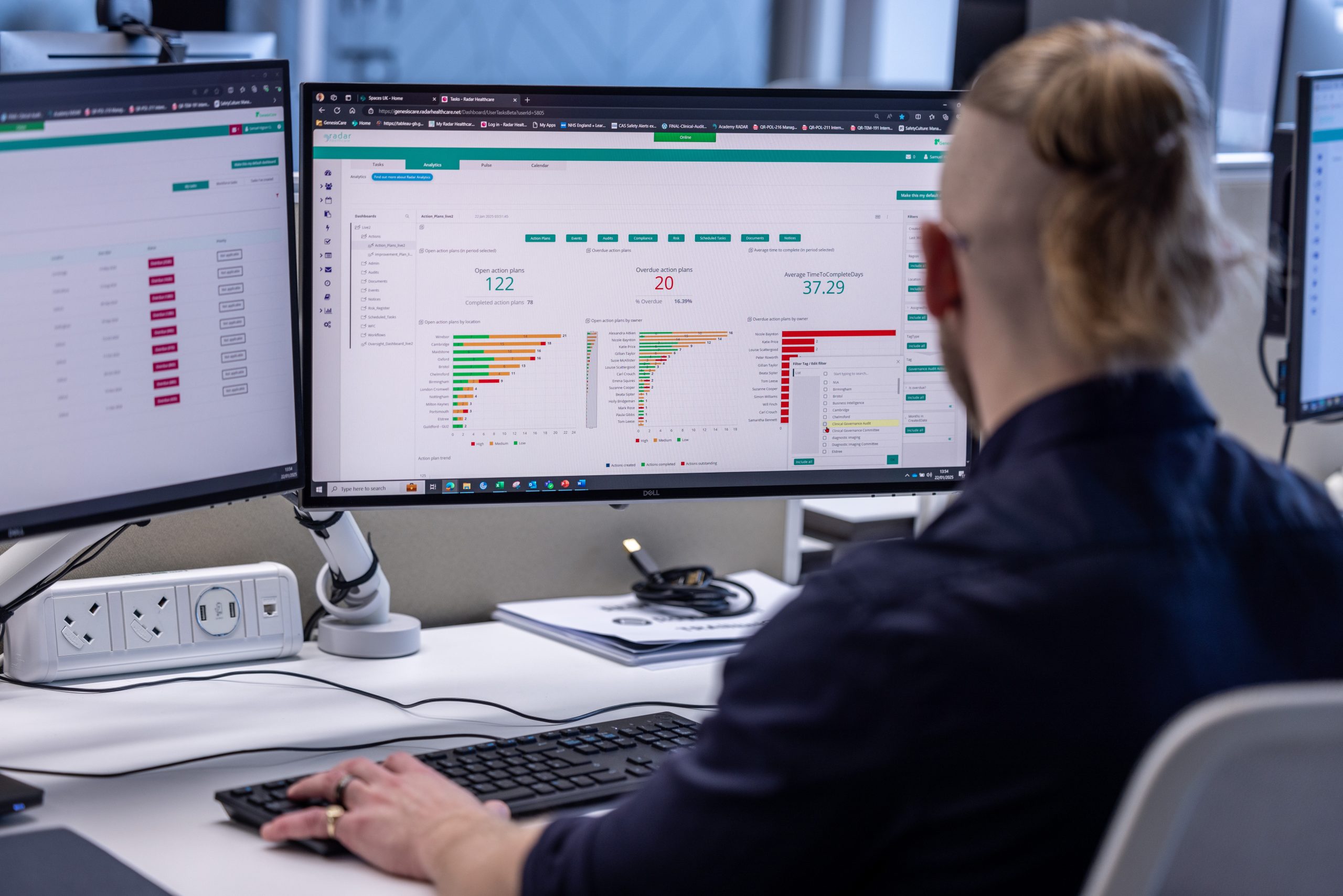
An integrated governance platform starts from the premise that governance functions are inherently connected, and builds that connectivity in from the start. When incident reporting, risk management, audit tracking, compliance monitoring and action management all live in the same platform — with shared data and a single source of truth — the governance picture changes fundamentally.
Incidents link to risk
An incident is recorded and automatically linked to the relevant risk — no manual translation required.
Audits generate actions
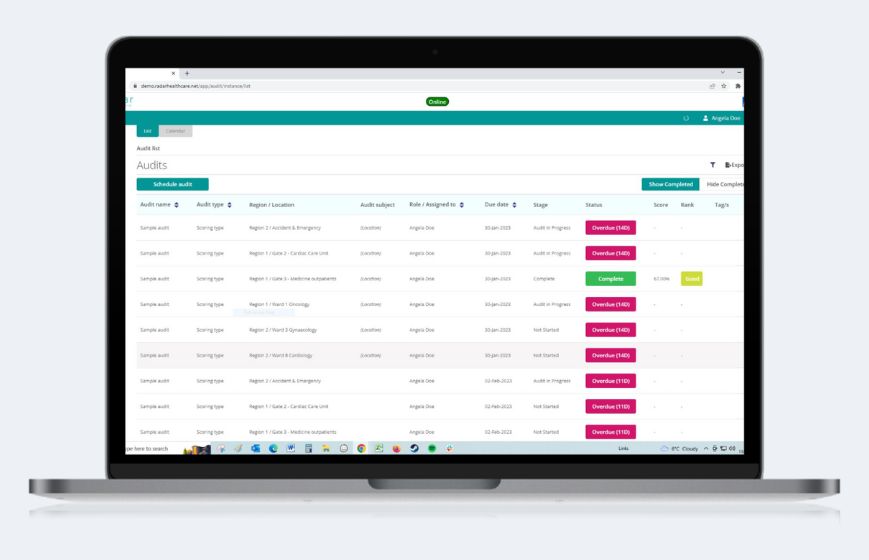
Audit findings become tracked actions in the same platform, assigned to owners with evidence at completion.
Leadership sees all of it
Group Directors see the full picture across every site in real time — no phone calls, no assembled reports.
The speed of learning accelerates. The accountability at every level of the organisation strengthens. And when the CQC inspector arrives, the evidence is not prepared for the inspection — it already exists, built continuously through normal governance activity.
What about existing care planning systems?
One concern that arises consistently is what happens to the care planning tools, including PCS, Nourish and many more that are already in place. Frontline teams have learned these systems. Care records live in them. Changing them would be disruptive and, frankly, unnecessary — care planning and governance are different functions.
“At PCS, we believe care providers get the best outcomes when they can choose best-of-breed solutions that excel in their specialist areas, rather than relying on a single platform trying to do everything. Radar Healthcare’s strength in risk, quality and compliance management makes them a natural integration partner within the PCS ecosystem.” Andy Houghton, Commercial Partnerships Manager at PCS.
“An integrated governance platform should sit above existing care planning and clinical systems, adding the governance layer those systems were never designed to provide – without asking frontline teams to change how they work.”
Rhian Bulmer, Chief Customer Officer at Radar Healthcare
Radar Healthcare is built on precisely this model. Care teams continue to use the tools they know. Group Directors, Regional Managers and boards gain the connected governance picture they have always needed through our intelligent integrations. So how does this work in action?
We have a selection of resources below to help bring this to life. If you want to discuss in more detail, just schedule some time with us.
See the integration in action
Want to see how this works in practice? This video demo explains the integration between Radar Healthcare’s governance, risk and compliance software and Nourish’s care planning software, showing exactly how it works and the benefits it delivers to carers and residents.
Alongside this, you can view a simple visual overview of the process – highlighting how incidents flow seamlessly between systems, reduce duplication, and feed learnings back into care planning to improve outcomes.
View our integrations infographic
Evaluating the decision for your care group
The most useful questions to ask are not about features. They are about outcomes.
Can the governance lead answer a board question about incident trends, audit completion and open risk items across the whole group — right now, without preparation? Can a Regional Manager see, at a glance, which of their sites needs attention this week? When an investigation generates recommendations, is there a clear, auditable trail from recommendation to action to verified completion?
If the answer to any of these is no, or not without significant manual effort, the governance infrastructure is not delivering what a group at scale requires.
The care groups that perform consistently well in CQC Well-Led assessments, go into board meetings with confidence, and build genuine learning cultures — these organisations have made a clear decision. They have invested in connected governance infrastructure rather than trying to assemble it from disconnected parts.
For care groups currently managing governance across multiple point solutions or spreadsheet-based processes, the most effective transitions start with the area of greatest friction — usually incident reporting and risk, or audit management — and build from there. What changes first is visibility. And visibility changes everything that follows.