


Interview with Sharon Stewart, Director of Clinical Governance and Quality Improvement, Circle Health Group
Q: Can you introduce yourself and your role?
A: I’m Sharon Stewart, Director of Clinical Governance and Quality Improvement for Circle Health Group. As Director of Clinical Governance, it’s important that I review all of the data entered into Radar Healthcare. This allows me to understand the themes and trends emerging from incidents reported across our hospitals. We have 53 hospitals in the group, all of which are inputting data. It’s essential that we carry out detailed analysis of that data to identify key elements related to patient safety and prevention. This enables us to help prevent future incidents from occurring by sharing lessons learned across the business with all of our staff.
Q: Can you talk about your Radar Healthcare journey?
A: Having worked at Circle Health Group for a number of years, we’ve used different systems. But with Radar Healthcare, we’ve been able to bring everything into one place – incident management, safety alerts, risk register, the audit programme – all together. It gives us one clear action plan, not just at the hospital level but also at the corporate level. It’s much easier to pull reports and take a more focused approach, without the need to dip in and out of different systems.
Q: Does that help you in your role as well?
A: It does. It gives me clear oversight of all the activity across our 53 hospitals. That oversight increases my assurance around data quality and allows me to focus on specific areas in a more detailed way. The analytics within Radar Healthcare are absolutely amazing – I can pull and filter reports and really extract the key messages I want to share across the group. That means teams can focus their attention on the most important areas, rather than being distracted by everything at once.
Q: Has it helped you focus on things that go well, as well as areas for improvement?
A: It’s absolutely helped us identify good practice across the group and share it widely. Often we focus on what hasn’t gone well, which is important for learning and improvement. But we treat thousands of patients every day, and it’s equally important to share the excellent care that takes place – from our hospitals in Scotland to the South Coast to the North West. Sharing those positive stories helps us demonstrate the quality care we deliver daily.
That’s something we really want to show – the positive side. There can be an overarching negativity sometimes, but sharing success stories can shift that narrative.
Q: Does that change the culture?
A: It really does. It helps staff feel proud of where they work. They want to do a good job for patients, provide safe and effective care, and contribute to quality improvement. We feed that into our corporate programmes as well.
Q: Have you noticed any particular themes or changes since bringing all systems into one place?
A: Having everything in one place has really helped us focus on training and education. Radar Healthcare’s built-in prompts guide staff through new systems and processes. That oversight also lets us identify where teams may need more support or where implementation isn’t progressing as planned. It allows us to act on that quickly and in a more focused way.
Q: How do digital systems enhance efficiency for your team and for healthcare more broadly?
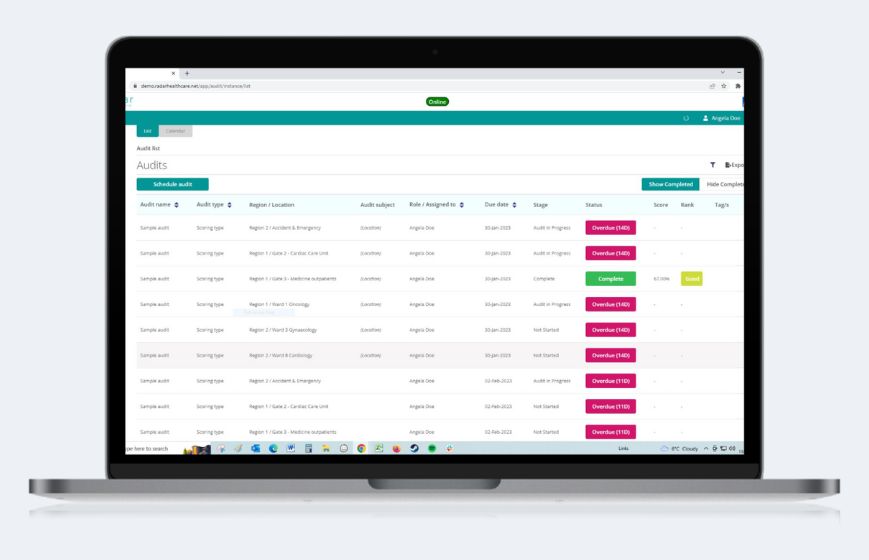
A: Each member of the Clinical Governance team has their work captured within Radar Healthcare, and having it all centralised improves the way we work and prepare for meetings. It enables us to focus our attention on key areas like training and development, quality improvement, patient satisfaction, audits, incident management, and PSIRF.
It brings all the information together, and the analytics allow us to be more efficient, focused, and proactive in our work.
Q: Do you use the data live during meetings?
A: Yes, that’s something we’ve introduced. For example, in our weekly PSIRG oversight meetings, we use Radar Live and dashboards. It saves time – we no longer need to create tables or copy and paste data into reports. Everything is live and up to date, as entered by the hospital teams. That alone has made our processes much more efficient.
We’re also reviewing risk registers live during clinical governance meetings. We display the register within the system and go through key risks, their current status, and any outstanding actions. Everyone in the meeting can see the same information at the same time, which makes decision-making quicker and clearer.
Q: How do you see digital systems evolving in the future?
A: Digital progression is inevitable and moving quickly. The ease of use of Radar Healthcare supports our open and transparent reporting culture. Because it’s so user-friendly, staff don’t feel uncomfortable reporting incidents, which is a huge benefit.
Looking ahead, there’s a lot of discussion around AI and how it could be applied, for instance, in complaints management or driving further efficiencies. While it’s not something we’re implementing right now, it’s certainly an area to watch for future development.
But above all, having a good reporting culture, supported by an easy-to-use system, is vital for any healthcare organisation. Radar Healthcare allows us to maintain complete oversight across all 53 of our hospitals.
Q: Has having that level of oversight helped your team focus and drive change?
A: Definitely. Having all our data in Radar Healthcare has enabled my team to focus on delivering key strategies including our Patient Safety Strategy, Patient Experience Strategy, and our Quality Improvement Strategy.
By reviewing incidents and feedback, we’ve been able to clearly define and progress our objectives for the year. That focus will positively impact patient care going forward.
Q: What advice would you give to others implementing a system like Radar Healthcare?
A: My biggest advice would be to ensure you have a strong support team, not just internally but also externally from your system provider. The Radar Healthcare team has been incredibly responsive and supportive, with regular contact and meetings that help shape the system around our needs.
When we first procured the system, we talked about wanting more than just a supplier, we wanted a true technology partner. That’s exactly what we’ve had. It’s allowed us to develop a bespoke solution that meets the needs of our regional and corporate teams and, ultimately, helps us improve outcomes for patients.
Q: What’s your favourite feature in Radar Healthcare?
A: The more you use Radar Healthcare, the easier and more intuitive it becomes and the more you want to use it. I personally love the dashboards and analytics.
I also love the Pulse alerts, when something crosses a threshold I’ve set, I get notified immediately. That allows me to focus attention on that area and bring it to others’ attention quickly. It’s made me more efficient and focused in my role.
Q: Would you recommend Radar Healthcare to others?
A: I absolutely would. The support behind the implementation, the training, and the ease of use for teams all make it a system I’d highly recommend to other organisations. It makes a real difference.
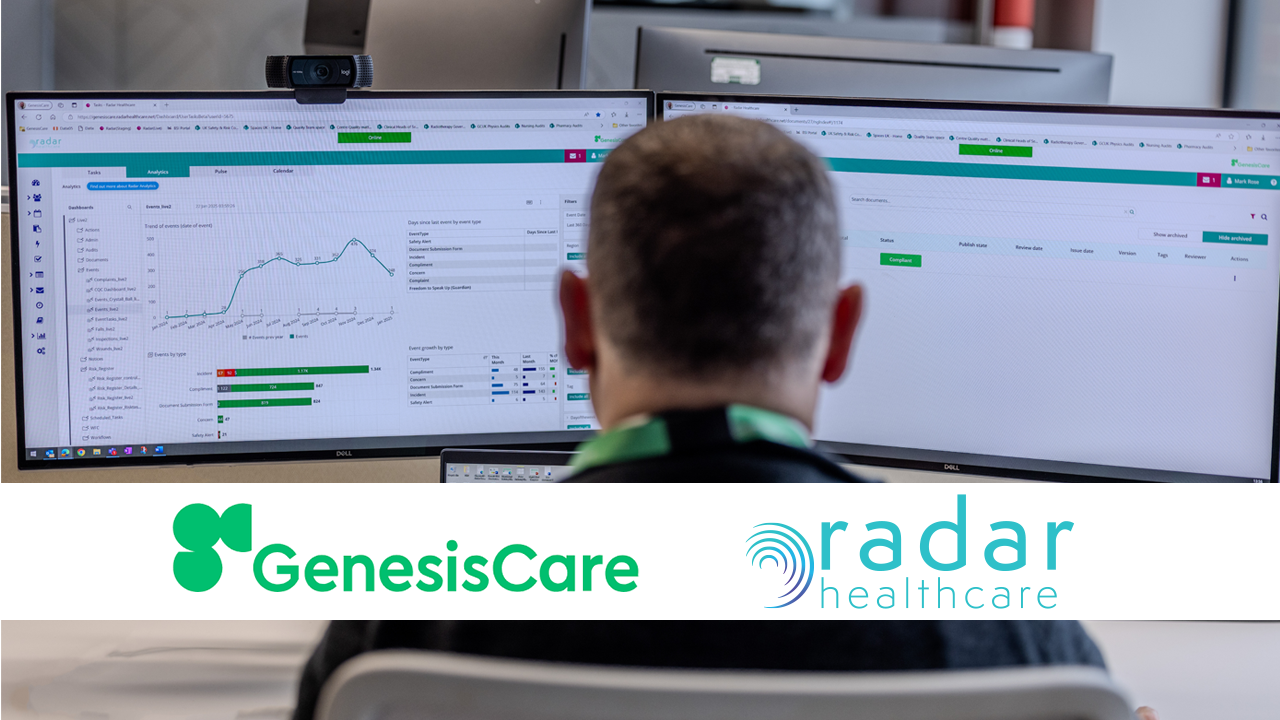
From floor to board level, how GenesisCare UK is successfully partnering with Radar Healthcare
The story behind the partnership between Circle Health Group and Radar Healthcare
Embedding PSIRF at Scale: Interview with Emma Watson, PSIRF Lead