


Interview with Emma Watson, Former PSIRF Lead at Circle Health Group
Q: Can you introduce yourself and your role?
A: My name’s Emma Watson, and I am the PSIRF Lead for Circle Health Group. I implemented PSIRF two years ago and now work on embedding PSIRF across the whole group. The introduction of PSIRF was a significant change. Simon and I worked together to develop a bespoke system where PSIRF was built into the algorithm, so “PSIRF” is embedded in everything we do within Radar Healthcare right from the outset.
Q: How did you go about building PSIRF into the algorithm?
A: When it came to designing our Patient Safety Incident Response Plan, we already knew from past datasets which incidents occurred most often. PSIRF aims to investigate those incidents proportionately. So, we developed our SEIPS – (system engineering initiative for patient safety) model and embedded it within Radar Healthcare. If one of those incidents is reported by a site, it automatically triggers an event-questioning workflow that may lead them into the SEIPS model. This enables them to carry out the investigation directly within Radar Healthcare, with all the necessary information in one place.
Q: Could you outline the Patient Safety Incident Response Framework (PSIRF) used at Circle Health Group?
A: PSIRF was introduced as a national NHS directive by NHS England, and Circle Health Group opted to adopt it. It means we’ve moved away from the Serious Incident Framework to a more streamlined, proportionate, and patient-focused approach to investigating patient safety incidents. It reduces the number of large-scale investigations and ensures more incidents are managed locally at site level.
Q: How is Radar Healthcare helping the group manage incidents and decide how to respond?
A: Creating these algorithms in a bespoke way within Radar Healthcare has allowed us to see more of what’s going on beneath the surface. For example, if we use the SEIPS model to investigate a patient fall, we can see the contributing factors live within Radar Healthcare. Because it’s embedded in the system, I can compare one investigation to another and identify themes across investigations – something we couldn’t do with our previous system. That’s where Radar Healthcare’s intelligence really supports incident management.
Q: What’s the benefit of being able to compare investigations?
A: It allows us to triangulate effectively. If there’s a specific issue at one site, we can quickly see whether that issue is also present elsewhere. It enables faster, broader fixes rather than waiting for escalation from individual sites. As soon as fields are completed in Radar Healthcare, I can see them, without delay, and compare the same type of incident across all 53 sites.
Q: What’s the impact on patients?
A: If an issue arises at one site, triangulating data helps us act across the whole group to prevent recurrence, without having to wait for traditional escalation. That means we can drive real-time improvement.
Also, if we’re not getting the data we need, we can easily update the system. For example, in the latest version of our Patient Safety Incident Response Plan, we added questions around falls. We now ask what type of anaesthetic the patient received, not because it caused the incident directly, but because it helps us trend data. We can begin to understand whether general anaesthesia correlates with more falls than spinal anaesthesia, or whether interventions like caffeinated drinks or intentional rounding impact fall rates. These small additions create real-time quality improvement.
Q: Have analytics supported this approach?
A: Yes, definitely. We haven’t seen a major shift in the types of incidents reported – that was expected. But we’ve enhanced the data we collect by adding bespoke questions. We’re no longer relying just on top-level info; we can ask more detailed questions at the point of reporting. That drives quality improvement and helps us be smarter in future iterations of the PSIRP
Sites can now answer yes/no questions directly, quickly and at the front line, so we’re not dependent on back-office teams or delayed workflows. It’s real-time data entry by frontline nurses, and that has made a huge impact on how we manage quality and risk.
Q: What metrics are you using to measure impact?
A: When we first implemented Radar Healthcare, incident reporting dropped sharply, that was expected as it was a new system and people needed time to adapt. What we didn’t expect was that not only would we return to our previous levels, but we’d exceed them.
Incident reporting has increased overall, and more importantly, we’ve seen a significant increase in reports that reach our highest-level committee, the Patient Safety Incident Review Group. At the same time, we’ve managed to shift more investigations to be handled locally, making them more proportionate.
So, while the number of incidents has increased, fewer are escalated to full investigations like root cause analyses. We’ve effectively seen both more data and more appropriate handling of that data.
Q: Have you seen any measurable changes in patient outcomes yet?
A: That’s hard to say definitively at this stage as we’re only two years in. We’ve seen increased reporting and a decrease in major incidents, which is encouraging.
We’ve seen a slight reduction in DVT (deep vein thrombosis) incidents, but also a slight increase in falls and incidents during cancelled operations. With the size of our organisation and volume of incidents, it’s still early days to draw strong conclusions but we’re definitely moving in the right direction.
Q: What does the future look like for PSIRF?
A: PSIRF is probably the biggest change we’ve seen in healthcare governance in 20 years. As we move forward, my goal is to eliminate paper entirely. I want all investigations, especially lower-level ones, to be conducted live within Radar Healthcare.
We’re already doing this for some types of incidents. Having analytics available helps us drill deeper into investigations. Instead of comparing paper reports, we’ll be comparing datasets within Radar Healthcare. That’s the gold standard for robust, real-time analysis.
Q: How has Radar Healthcare structured your committee meetings?
A: Our PSIRF committee meets weekly to review significant incidents and decide on investigations and regulatory reporting. It’s a high-level meeting.
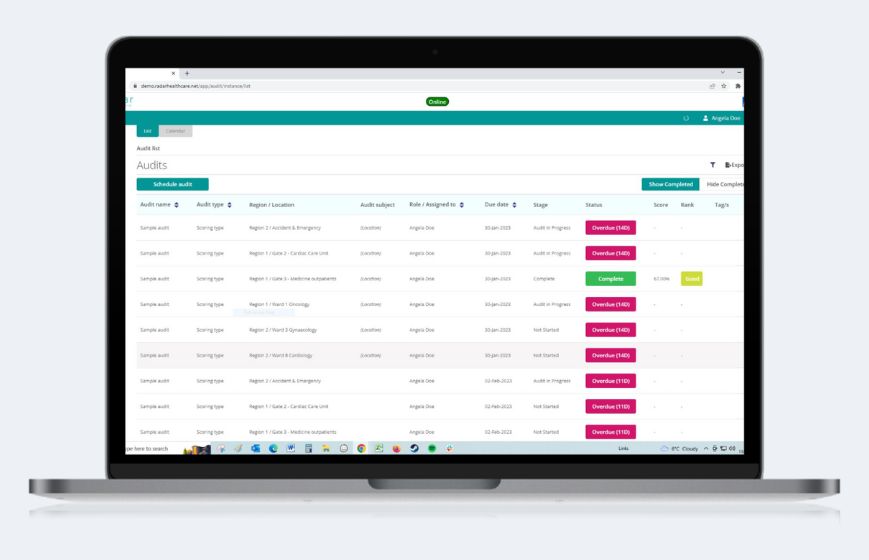
We now use Radar Healthcare live during those meetings. Every incident includes an “SBAR” field (Situation, Background, Actions, and Recommendations), which is part of the incident form. I open Radar Healthcare during the meeting and share my screen, we go through incidents live, including updates made just minutes earlier.
Any outcomes or recommendations are built into Radar Healthcare workflows, sent to the sites as tasks, and tracked there. There’s no separate tracking system. Even if someone is unexpectedly absent, tasks can be reassigned so we don’t lose momentum.
Q: How does this compare to your previous process?
A: Previously, we used paper forms emailed in from sites. Those forms were sometimes outdated by the time of our meetings. If a site sent something Monday for a Thursday meeting, we had no way of knowing what had changed in between.
Radar Healthcare bridges that gap. It gives us a live, accurate view of what’s happening, eliminating delays and version control issues.
Q: How do you see PSIRF evolving?
A: PSIRF is about proportionate investigations and engaging patients in the process. It encourages co-production of investigations and discourages unnecessary work.
It supports thematic reviews over isolated incidents and promotes systemic quality improvement. Not every incident requires investigation. Sometimes, a near miss or service issue isn’t a true patient safety event but it still reveals a system weakness we can improve.
PSIRF’s evolution will be about focusing resources wisely. It’s lean by design. I hope this approach will help us finally reduce long-standing, recurring incidents in the NHS and make real, lasting improvements to care quality.

Patient Safety Incident Response Framework (PSIRF) Compliant Software
How Ramsay Health Care UK is Transforming Patient Safety