


Interview with Simon Geoghegan Head of Clinical Data Reporting and Governance Systems at Circle Health Group
Q: Can you introduce yourself and your role?
A: I am Simon Geoghegan, Head of Clinical Data Reporting and Governance Systems at Circle Health Group. My role primarily involves working with our healthcare teams to maintain, manage, and lead the change management of the Radar Healthcare platform. I collaborate with different functions across the business to ensure the system is performing as required. I also support any internal or external changes needed to help us provide the best governance across all business functions.
Q: What has your Radar Healthcare journey been like?
A: I’ve been in the role for about 11 years now and have seen various iterations of governance systems. When I started, we were using a primarily paper-based system. We then transitioned to a fully digital system, initially just for incident and risk management. From there, we moved to Radar Healthcare, which encapsulates all our governance processes. So, we’ve gone from a paper-based incident management system to an all-in-one governance solution that includes incidents, risks, compliance, auditing, quality improvement, safety alerts, and more.
Q: What led to you choosing Radar Healthcare?
A: During the procurement phase, the first thing we wanted was an all-in-one system—something that allowed us to triangulate our incidents with risks and audits. That was the initial appeal. As we progressed through procurement, it became clear that Radar Healthcare had a strong technology partnership approach, which we valued highly. That’s what really made the difference. It’s been great to see that relationship bear fruit over the past two years.
Q: When you were going through procurement, was there anything specific about Radar Healthcare that stood out?
A: The analytics, and more importantly, where the analytics could go, were a big differentiator. Many systems are quite similar across the industry, but Radar Healthcare’s analytics capability set it apart. I’m a self-proclaimed geek, so the analytics side was always going to appeal to me. We’re now in the process of fully migrating over to the analytics platform, and I’m really keen on bringing triangulation to life and delivering meaningful insights for our hospitals and governance committees.
Q: Is there anything within the system that you’re particularly looking forward to seeing in the future?
A: I think the advancements in analytics, which I’ve mentioned a couple of times, are key. We’re keen to move beyond just counting incidents, we want to layer that with audit data to understand rates and add context. Having that capability built into Radar Healthcare will be incredibly powerful for us. I’m also excited about being involved in shaping the new framework and the future direction of the system.
Q: Is being involved in development conversations, like the new framework groups, something you value?
A: Yes, it goes back to the technology partnership I mentioned earlier. Radar Healthcare has shown a real interest in understanding what works for us at Circle Health Group and learning from our feedback. I’m probably quite a demanding customer, but that dynamic benefits both Circle Health Group and Radar Healthcare by pushing the product to be as good as it can be. We’ve been involved in beta testing and workshops, and that early engagement gives us useful insight into where the product is headed.
Q: Is testing and shaping the system something you find rewarding?
A: Absolutely. We’ve taken part in several beta tests and workshops around the new framework. It’s been valuable to have that engagement with Radar Healthcare. It gives me insight into the product’s direction, which I can feed back to our staff and board to help them understand what’s possible in the future.
Q: You’ve talked before about wanting to learn from what’s gone right as well as what’s gone wrong. Does Radar Healthcare help with that?
A: Yes, definitely. The system’s flexibility allows us to tailor it to our needs. While some tools like dashboards are available out of the box, the ability to customise really helps us learn in a way that’s specific to Circle Health Group. That deeper insight makes a big difference.
Q: Are there any modules or features that stand out in terms of flexibility?
A: The Events module is the most flexible. We’ve used it extensively over the past 12 months and tailored it to meet Circle Health Group’s specific needs. That represents a significant culture change for us. We’ve also been able to eliminate over 12 manual processes because of that flexibility. On the analytics side, we’ve gone beyond the default dashboards to build our own that align with our governance and assurance requirements.
Q: Was building your own dashboards important?
A: Very. The out-of-the-box dashboards are useful for managing Radar Healthcare generally, but because we have so many different committees looking at specific aspects of governance, we needed to customise information for each group. That’s helped us better support their agendas. I’ve probably got Damian on speed dial to help with analytics, but the platform is intuitive enough to try things internally too. My experience with tools like Power BI has helped with that, and the Radar Healthcare team has been a great support.
Q: How do you ensure people learn from the insights in Radar Healthcare?
A: We’ve customised workflows and forms to capture lessons learned, and we’re still in the early stages of sharing that insight. The next step is to communicate those findings through our governance and assurance framework and committee agendas. Radar Healthcare’s flexibility supports that, and our structure allows us to cascade learnings across the organisation.
Q: What role does Radar Healthcare play in improving patient safety and services?
A: It’s been massive for us. Previously, we couldn’t triangulate data meaningfully. Now we can overlap incidents with audits and other governance data to get a fuller picture of patient safety across the group. That all-in-one approach we wanted during procurement is really paying off.
Q: Do patients expect more from you as a private healthcare provider?
A: I don’t think expectations differ in terms of patient safety. Patients know there are inherent risks in healthcare, whether in the NHS or private sector. What might differ is the expectation around the environment—cleaner facilities, more comfort—but safety is paramount in every setting.
Q: How do you find working with the wider Radar Healthcare team?
A: It’s great. The customer support team is responsive and happy to jump on calls, which helps solve problems more effectively than email sometimes. The product team keeps us in the loop on the roadmap, so we’ve had good engagement across the board.
Q: How valuable have the Radar Healthcare user groups been?
A: Very helpful. They let us share best practices and see how others are using the system. At the first meeting, we all realised we were using Radar Healthcare differently. Since then, we’ve worked towards more consistent usage. It’s also helped build relationships across the independent sector, which is important. While we may be commercial competitors, there should be no competition in patient safety.
Q: What’s your favourite feature in Radar Healthcare?
A: Definitely the analytics. I enjoy diving into data and building insights through visuals. I want Circle Health Group to lead in that area and be first to adopt new capabilities as they’re released.
Q: Do you build dashboards for individuals as well as committees?
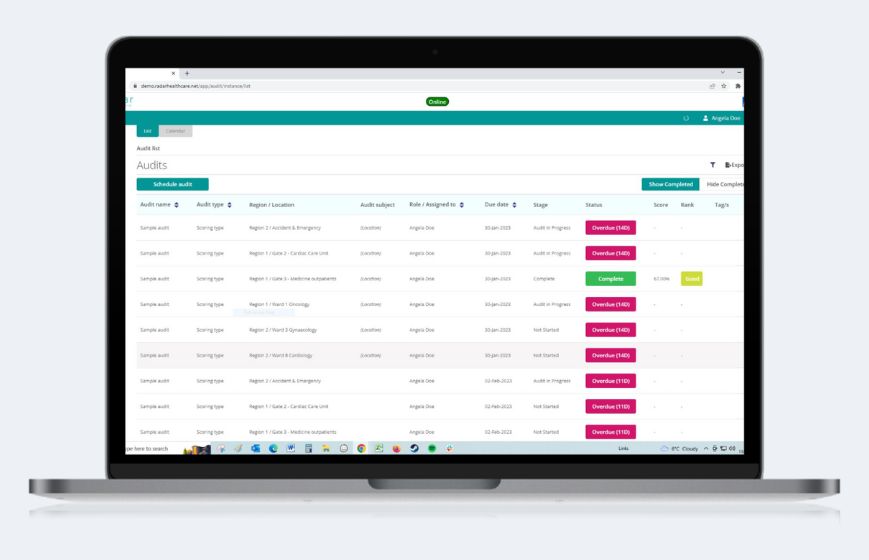
A: Yes. We have dashboards for clinical governance, health and safety, and more. We also have site-level dashboards to help manage open actions. Radar Healthcare is a much bigger system than we were used to, so those dashboards help staff quickly see what needs attention.
Q: Can you talk about implementing PSIRF alongside Radar Healthcare?
A: It’s been a challenge, balancing system and cultural changes. Our goal was to make Radar Healthcare guide staff through PSIRF processes without overwhelming them. We didn’t want them to worry about whether something was PSIRF-related, we just wanted the system to tell them what to do and when. That’s been a big success, and the dashboard makes it easier for staff to focus on clinical duties without being tied to their desks.
Q: Have you developed processes like logic and events in-house?
A: Yes, and it’s been an evolving process since we went live in December 2023. We’ve made many changes, learning as we go. We’re just launching our second implementation phase and making more adjustments. It’s an iterative journey, and I don’t see that ever stopping. We’re always looking to align the system with user needs and reporting requirements.
Q: How do you ensure continuous improvement?
A: Being part of the user group helps us influence the product roadmap, especially from the independent sector’s perspective. Radar Healthcare’s flexibility also means we can take advantage of new features like enhanced audits. We’re usually first to adopt upgrades and explore their benefits.
Q: How do you plan to make the most of analytics and dashboards?
A: We already had a solid reporting framework in Excel, which we’ve adapted. The key is working with committees to understand their needs and building dashboards around that. If something’s beyond our internal capabilities, the Radar Healthcare team steps in to support us.
Q: Has Radar Healthcare helped you deliver more targeted insights to different stakeholders?
A: Yes. For example, in health and safety, we’ve updated incident categories and are amalgamating audits. Radar Healthcare helped us identify efficiencies and improve reporting.
Q: How do you measure the impact of Radar Healthcare?
A: It’s now fully embedded. It took time – especially with the simultaneous rollout of PSIRF – but now it’s part of our daily language. Staff are even suggesting new uses for Radar Healthcare, which shows how well it’s embedded and how much potential they see.
Q: Can you talk about the Governance Assurance and Accountability Framework (GAAF)?
A: The GAAF defines how we report and structure our governance processes. While it wasn’t created for Radar Healthcare, it aligns very well with the platform. We can use Radar Healthcare’s modules and analytics to support that framework effectively.
Q: What’s been the single biggest benefit of Radar Healthcare?
A: Having everything in one place. It’s a huge efficiency boost. Staff don’t need to check multiple systems. All actions and insights are in one place, and they know exactly what they need to do.
Q: Does Radar Healthcare help you monitor performance across your sites?
A: Yes. From an organisational level, we can track incidents, audits, and outstanding actions. Each site has the same view at its level, so everyone knows where they stand.
Q: What feedback have you received from teams using Radar Healthcare?
A: The main thing is how beneficial the all-in-one system is. Now that Radar Healthcare and PSIRF are embedded, staff are really seeing the benefits. It’s become part of our daily workflow.
Q: What’s your long-term vision for Radar Healthcare at Circle Health Group?
A: I want us to move beyond focusing only on negative events like incidents and complaints. These are important, but we should also learn from what’s gone right. Reflecting on good care can have a big psychological impact on staff. I’d love to see the sector embrace that balance, celebrating success as much as investigating failure.
More about the technology partnership
As the UK’s largest private hospital group, Circle Health Group operates 54 hospitals nationwide. Their mission is to deliver, safe, effective and high-quality care to patients who pay for themselves, are supported by private insurance or who are supported by the NHS at each of their locations across the UK. Key to making good on that commitment is a robust governance framework. In Radar Healthcare, Circle Health Group found not just a system, but a true “technology partner” with whom they could build upon the foundations of its organisational governance processes and culture.

You might also be interested in...
GenesisCare UK's successful partnership with Radar Healthcare
People First, Technology Second: How Ramsay Health Care UK is Transforming Patient Safety
Embedding PSIRF at Scale: Interview with Emma Watson