


Interview with Anderley Newnham, Quality and Risk Manager at Circle Health Group's Mount Alvernia Hospital
Q: Can you introduce yourself and your role?
A: My name is Anderley Newnham. I work at Mount Alvernia Hospital in Guildford as a Quality and Risk Manager, a role I’ve held for the past ten years. It’s an extremely varied position involving many areas of the hospital, but it primarily focuses on governance activities. That includes incident reviews, audit assessments, oversight of the risk register, and supporting staff across all governance-related matters.
Day to day, my main responsibilities are helping staff and the hospital review incidents, develop and complete audits, monitor the risk register, and provide assurance to hospital committees that we are maintaining safe service levels.
Q: How has patient safety management evolved over the last 10 years?
A: Over the past decade, patient safety management has significantly evolved. I’ve used a number of systems to support this, and most recently we’ve introduced Radar Healthcare, which is by far the most advanced system we’ve used to date.
Q: What features of Radar Healthcare do you use regularly?
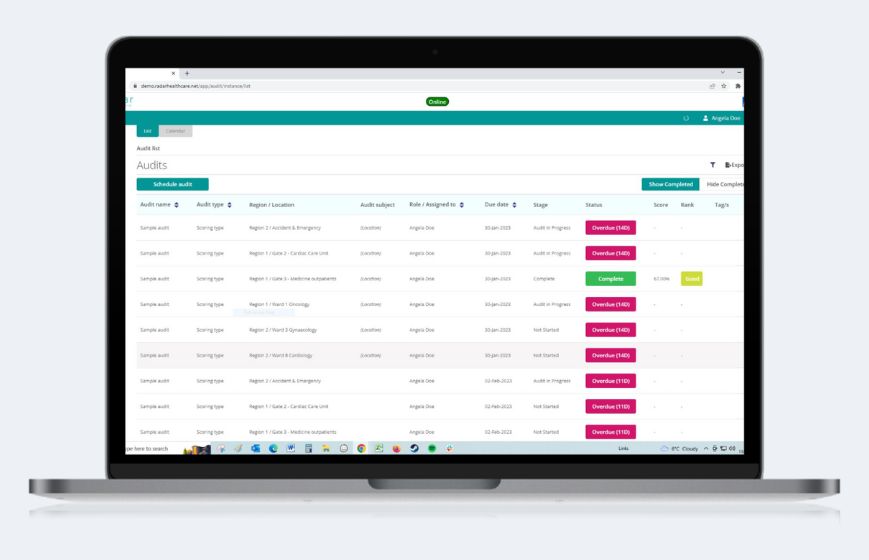
A: On a daily basis, I use several features within Radar Healthcare, including incident management, the audit programme, the risk register, and the complaints and feedback module.
Q: How has having all of those features in one system helped, especially with incidents?
A: The utilisation of Radar Healthcare has improved immensely over the past 18 months since we introduced it, particularly in incident reporting, but also across all the other governance areas. Having everything in one place is a major advantage.
Q: What do you like most about how Radar Healthcare brings everything together?
A: What I particularly like about Radar Healthcare is that it allows me to access all the elements relevant to my role in one view. The task list feature helps me prioritise work efficiently and gives early insight into key issues for the day. It also supports other team members in identifying where they should focus their efforts.
Q: Would you say it helps keep you on track?
A: Absolutely. The analytics dashboards have been especially helpful, supporting both myself and my colleagues in prioritising governance-related tasks.
Q: Have you used the action plans or other modules to support your work?
A: Yes. Since we implemented Radar Healthcare about three years ago, the system has evolved significantly. One key improvement is the ability to link incidents and complaints, and bring everything together through comprehensive action plans.
For example, we can tag items for the Clinical Governance Committee or create specific action plans for PLACE audits. This ability to pull targeted action plans for specific committees is a real strength.
Q: Does the system make it easier to capture and present information for committees?
A: Definitely. For my role, it’s essential to have a central system where I can gather everything I need in one place. Radar Healthcare allows me to do this efficiently.
For example, I can capture actions related to PLACE reviews and store them in a single repository. This has significantly improved how I work day-to-day.
Q: Does Radar Healthcare support collaboration with quality managers across other hospitals?
A: Yes, especially through the analytics dashboards. These have been revolutionary in my role. I can take key performance indicators to the Clinical Governance Committee and also share insights with other departments.
The console dashboard lets me track incidents that are overdue by more than 40 days, helping me prioritise their completion. I can also monitor audit programme progress each month and support audit leads accordingly.
Q: Have you seen any efficiency gains by moving to a digital system?
A: Absolutely. Radar Healthcare acts as a single repository for all governance areas – incidents, audits, risks, complaints, and feedback. That alone makes it far more efficient than any paper-based or fragmented system we’ve used before.
It gives me clear oversight and allows me to help others prioritise their tasks more effectively. The knock-on effect is improved performance across all departments.
Q: Does the task feature support wider team efficiency?
A: The task management feature is essential for organising my own workload, but equally important is how it supports my colleagues. It gives them visibility of their team’s tasks and supports overall departmental efficiency.
Q: Do you find Radar Healthcare easy to use?
A: I do, yes. But as with any new system, the success of implementation depends on strong training and support, especially for staff with limited experience of digital systems. Radar Healthcare offers helpful tools like training videos and FAQs, which really assist with onboarding.
Q: How have you found working with the Radar Healthcare support team?
A: As a Quality and Risk Manager, I’ve found the Radar Healthcare support team to be very responsive. They’ve listened to our feedback and made improvements where needed. The introduction of the analytics dashboards and enhanced search capabilities, like searching by consultant name, has been especially helpful, for example in supporting biennial consultant reviews.
Q: Has Radar Healthcare helped with governance oversight and data tracking?
A: Yes. The action plan function helps me ensure actions are completed in a timely manner and escalated to the appropriate committee if overdue.
The dashboards allow me to review data trends from the past 3–6 months and spot emerging themes. This supports further investigation and ensures we maintain a safe service.
Q: What feedback have you received from your team about using Radar Healthcare?
A: One key thing I always say is: the more you use the system, the more you get out of it. I’ve personally supported staff in using each feature, because understanding the system unlocks its full potential.
Of course, there’s always a learning curve. New systems can be intimidating, especially when they involve automation and unfamiliar workflows. But once people begin using Radar Healthcare regularly and seeing the impact, it becomes second nature.
Q: What advice would you give to others thinking of implementing Radar Healthcare?
A: My advice would be to carefully evaluate the specific needs of your organisation before implementation.
It’s vital to listen to all relevant stakeholders when developing your business case. Understand what their needs are and how they’ll interact with the system. A solid project plan, shaped by those stakeholder views, will make the introduction smoother and more successful.
With any smart system like this, the more thought you put in up front, the more value you’ll get out of it.

Interview with Simon Geoghegan Head of Clinical Data Reporting and Governance Systems at Circle Health Group
Embedding PSIRF at Scale: Interview with Emma Watson, PSIRF Lead
Interview with Sharon Stewart, Director of Clinical Governance and Quality Improvement, Circle Health Group