

CARE HOME AND CARE GROUP SOFTWARE
Spot risk earlier across every home
Radar Healthcare gives multi-site care groups one connected view of incidents, audits, risks, actions and compliance evidence, helping leaders prevent repeat issues, maintain consistent standards and stay inspection-ready across every service.
As care groups grow, small issues can become harder to see
Processes vary between homes. Evidence sits in different places. Regional teams rely on manual updates. By the time a pattern is visible, the issue may already have affected residents, staff or inspection confidence.
Radar Healthcare brings your quality, risk and compliance data together so leaders can identify early warning signs, support services faster and prove improvement across the group.
Book a tailored demoBuilt to support better CQC outcomes
CQC confidence depends on more than individual records. Providers need to show consistent leadership, clear governance, effective learning and evidence that improvement is sustained.
- Demonstrate live oversight across homes and regions
- Evidence learning from incidents, audits and complaints
- Show how risks are identified, owned and managed
- Track improvement actions through to completion
- Prove that quality and safety activity is ongoing, not reactive
See patterns before they become problems
Radar Healthcare helps care groups identify homes with rising incident trends, repeated audit failures, overdue actions, emerging safeguarding themes, inconsistent compliance evidence and regional or service-level variation.
How much time could your teams save improving oversight across your care homes?
Estimate how much time and cost your organisation could save by improving incident reporting, reducing manual admin and connecting workflows across risk, actions and analytics.
Turn multi-site data into visibility, action and consistency
Move beyond siloed site reporting. Use connected governance data to spot risk earlier across homes, act faster and prove consistent quality and safety.
Spot risk across homes earlier
Identify homes with rising incident trends, repeated audit failures or inconsistent quality before issues escalate.
Intervene earlier and standardise care
Support homes with targeted action, track improvement plans and create consistent governance processes across every location.
Demonstrate consistent quality and outcomes
Show regulators and stakeholders clear evidence of oversight, learning and improvement across every service and region.
Designed for multi-site governance at scale
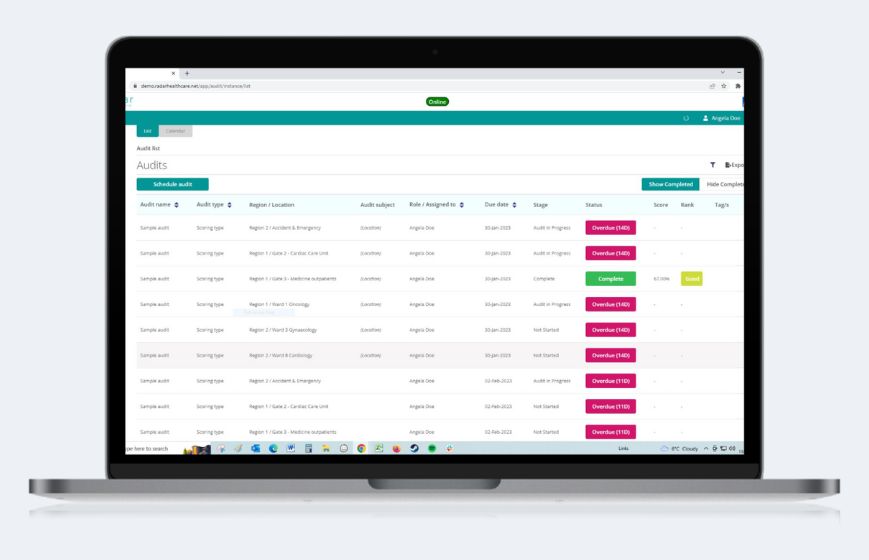
Give central and regional teams one connected view of incidents, audits, risks and actions so you can reduce variation, support services faster and prove quality and safety across your entire group.
Trusted by leading UK care groups and homes



“Since implementing Radar Healthcare, we can provide support to our services much faster than before. As a complex care provider, we support people who display behaviours of concern or have other risk factors. If we can reduce those events, people can enjoy a much better quality of life.”
“We now demonstrate positive outcomes, so we can use that as evidence to the CQC. If we encourage staff posting positive events as well as incidents on Radar Healthcare, we are going to be able to present these great experiences in our homes to our investors, the CQC and other regulators.”
“Previously, gathering data could take days. Now it takes minutes, and that time goes straight back to residents.”
“Radar Healthcare’s adaptability, simplicity, and reporting capabilities have not only streamlined our day-to-day operations but significantly improved governance. This positions our group for future success, and we eagerly anticipate the continued success of this partnership.”
“Thanks to Radar Healthcare’s expertise and support, events and audits have been successfully embedded across our services, strengthening our safety culture and improving how we respond to incidents.”
Ready for clearer oversight across every service?
FAQs
Large care groups typically need compliance software that brings incidents, audits, risks and improvement actions into a single, auditable system. This allows organisations to evidence governance, learning and oversight against the CQC’s key lines of enquiry (KLOEs), rather than relying on disconnected spreadsheets or local processes.
Platforms like Radar Healthcare are designed specifically for UK health and social care, enabling care groups to standardise assurance activity across sites while maintaining clear, real‑time evidence for inspections. The focus is not just recording activity, but demonstrating learning, accountability and continuous improvement at organisational level.
Inspectors increasingly expect care groups to show how they identify issues, learn from them and embed improvement across the organisation. Large providers typically evidence this by linking incidents, audits and complaints directly to improvement actions, tracking completion, and analysing trends over time.
Dedicated compliance and quality systems help care groups demonstrate this clearly by providing traceable records of decision‑making, action ownership and outcomes. Rather than presenting isolated examples, organisations can show inspectors how learning is governed, reviewed and acted upon consistently at group, regional and service level.
To standardise audits across multiple sites, care groups usually require a centralised audit management platform that supports consistent frameworks while allowing service‑level flexibility. These systems enable organisations to roll out shared audit templates, capture results in one place and automatically generate action plans that are tracked to completion.
Solutions such as Radar Healthcare support this approach by giving quality teams clear visibility across regions and services, helping ensure audits drive meaningful improvement rather than becoming a tick‑box exercise. This consistency is critical for governance, assurance and inspection readiness at scale.
Governance at care group level requires software that provides leadership teams with a clear, real‑time view of quality, risk and compliance across the entire organisation. This typically includes group‑wide reporting, trend analysis, escalation processes and evidence of oversight.
Rather than focusing on individual homes in isolation, platforms designed for complex care organisations support decision‑making at board, regional and service level. Radar Healthcare, for example, is used by large care groups to strengthen governance by centralising assurance activity and enabling leaders to act on emerging risks with confidence.
The most effective preparation tools for CQC inspections are those that allow evidence to be maintained continuously, rather than assembled at the last minute. Care groups often use compliance and quality systems that centralise policies, audits, incident data and improvement actions, making evidence readily available when inspections are announced.
By maintaining up‑to‑date dashboards and reports, organisations can demonstrate ongoing oversight, learning and improvement without disruptive manual collation. This approach supports more predictable, less stressful inspections and enables leadership teams to engage confidently with inspectors.
While generic GRC tools may support high‑level risk management, many lack the depth and context required for UK health and social care. Care groups often benefit from platforms designed specifically around CQC expectations, care workflows and regulatory language.
Systems such as Radar Healthcare are built with UK regulation in mind, supporting audits, incident management, governance and evidence gathering in a way that aligns with CQC frameworks. This sector‑specific design reduces complexity and helps organisations focus on quality improvement rather than system configuration.
Large care groups should look beyond basic data capture and focus on software that supports visibility, accountability and assurance at scale. Key considerations include the ability to standardise processes across services, provide real‑time leadership insight, support inspections, and track improvement actions effectively.
Equally important is usability for frontline staff and practical onboarding for complex organisations. Compliance, risk and quality software should strengthen governance without increasing administrative burden, helping care groups maintain consistent quality and confidence as they grow.